

What is a Chalazion?
The term chalazion (pronounced kah-la’-ze-on) comes from the Greek word meaning small lump. It refers to a swelling in the eyelid caused by chronic inflammation of one of the small oil-producing glands (meibomian glands) located in the upper and lower eyelids.
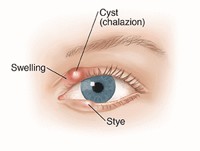
A chalazion is sometimes confused with a stye which also appears as a lump in the eyelid. A stye is an acute inflammatory infection of a lash follicle and forms a red sore lump near the edge of the eyelid. A Chalazion is usually a reaction to trapped oil secretions and is not caused by bacteria, although the site can become secondarily infected by bacteria. Chalazions tend to occur farther from the edge of the eyelid than styes (although a gradual swelling can be felt near the edge of the lid) and tend to “point” towards the inside or nose side of the eyelid. Occasionally, a chalazion can cause the entire eyelid to swell suddenly.
How are Chalazions and Styes Treated?
When a chalazion is small and without symptoms, it may disappear on its own. Usually, they do not disappear without treatment. If the chalazion is large, it may cause blurred vision by distorting the shape of the eye.
A chalazion or stye may be treated with any one or a combination of the following methods:
- Antibiotics and/or steroid ointment
- Hot Compress; Hot compresses can be applied in a variety of ways. The most effective way is to use a Bruder mask which is able to maintain adequate heat for 10 minutes. This should be applied at least twice a day against the closed lid. (Click here to watch a video on lid warming)
- Massage or expression of the glandular secretions (Click here to watch a video on lid massage)
- Surgical incision or excision
Chalazions and styes usually respond well to treatment, although some people are prone to recurrences and may require continued therapy. If a chalazion or stye recurs in the same place, your optometrist may suggest in office heat and expression to unclog the glands. Please contact the office if you require this type of treatment.